Social Listening & Audience Intelligence Guide for Media & Entertainment
Social Listening & Audience Intelligence Guide for Media & Entertainment
The old days of mass audiences tuning into a few TV channels are over. Now, viewers are everywhere—TikTok, YouTube, forums, and countless niche corners of the internet. That means the old marketing playbook? It just doesn’t cut it anymore. Box office numbers and ratings tell you what happened, sure, but they don’t explain why. And if you’re waiting for those numbers to react, you’re already behind.
That’s where Audience Intelligence comes in. It’s social listening evolved—listening not just to the noise but to the real conversations that show what fans actually think and feel. The very platforms scattering audiences are also giant, nonstop focus groups if you know how to tap into them. With tools like Pulsar, you can turn all that chatter into clear insights that help you spot trends early, avoid risks, and create content that truly connects. This is how media wins today.
What we are looking at:
- 1. Why Social Listening Matters for Media & Entertainment
- 2. Applying Audience Intelligence Across the Entertainment Lifecycle
- 2.1 Unlock Audience Insights — at Scale and in Real Time
- 2.2 Spot Cultural Trends & Narrative Shifts Before They Peak
- 2.3 Mitigate Risks and Manage Brand Reputation
- 2.4 Power Smarter Campaign & Content Strategies
- 2.5 Audience Segmentation and Targeting
- 3. The M&E Professional’s Toolkit — Mastering Audience Intelligence with Pulsar
- 3.1 The Microscope: Pulsar TRAC for Granular Analysis
- 3.2 The Telescope: Pulsar Narratives for Big‑Picture Understanding
- TRAC vs. Narratives: Two Lenses, One Ecosystem
- 4. A Practical Framework for Embedding Audience Intelligence
- Step 1: Set the Strategic Goal
- Step 2: Build Multi‑Layered Queries
- Step 3: Visualize Insights in Real Time
- Step 4: Act on Findings
- Step 5: Learn and Refine
- Conclusion: Audience‑Driven Leadership
1. Why Social Listening Matters for Media & Entertainment
For entertainment brands, online chatter isn’t background noise—it’s a live feed of audience reactions, ideas, and signals about what’s about to trend. A viral TikTok edit, a Facebook backlash, or a fan theory on X can all shape narrative momentum in hours, not weeks. The challenge isn’t finding these conversations; it’s knowing what they mean and how to act on them fast.
That’s why the real shift isn’t just from silence to listening—it’s from monitoring to intelligence. Social monitoring answers what happened. Social listening explains why it happened. Audience Intelligence adds the missing piece: who is driving it, and what happens next? This step unlocks untagged, cross-platform communities, maps behaviors and subcultures, and forecasts narrative shifts so brands can plan with foresight, not hindsight. It’s a move from counting mentions to decoding meaning—and then using it to lead culture rather than chase it.
This evolution unfolds in three stages:
| Social Monitoring (What) | Social Listening (Why) | Audience Intelligence (Who / What’s Next) | |
| Goal | Track mentions & respond | Understand sentiment & context | Map communities, forecast trends, activate strategy |
| Scope | Tagged posts & alerts | Entire conversation landscape | Cross-platform, untagged, segmented by behavior & subculture |
| Focus | Volume, reach, engagement | Themes, sentiment, narrative | Motivations, influence, cultural drivers |
| Outcome | Customer service, protection | Strategic planning & creative validation | Trend prediction, audience-led innovation |
2. Applying Audience Intelligence Across the Entertainment Lifecycle
2.1 Unlock Audience Insights — at Scale and in Real Time
Traditional ratings or post‑launch surveys tell you what happened after the fact. Social listening, by contrast, captures unfiltered opinions as they unfold—across TikTok, Twitch, Threads, forums and beyond. This real‑time view reveals shifting sentiment, fan preferences, and creative triggers before the data is old news, fueling faster, smarter content and acquisition decisions.
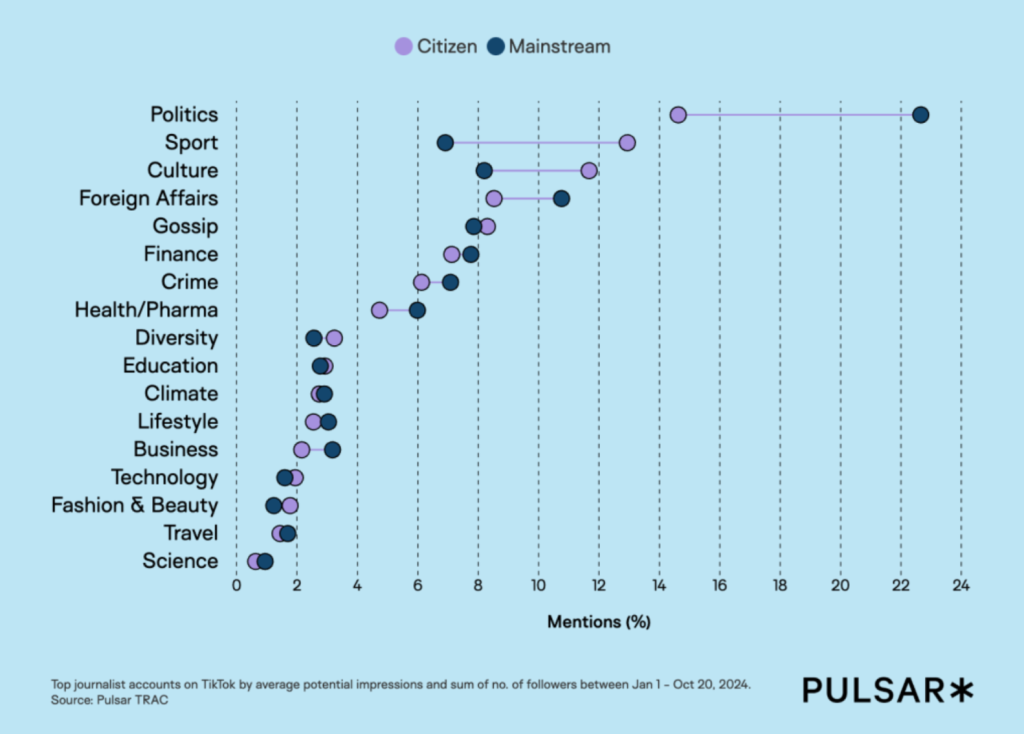
Case Study: TikTok Journalism
Pulsar’s analysis of TikTok’s impact on journalism revealed how audiences increasingly consume breaking news through short‑form, vertical video rather than traditional broadcast formats. The study identified how key news moments—from elections to celebrity scandals—were amplified and reframed by TikTok’s meme‑driven language and editing styles. For media brands, this insight informed newsroom strategies: adapting storytelling to match platform‑native formats and meeting younger audiences where they were already engaging with the news.
2.2 Spot Cultural Trends & Narrative Shifts Before They Peak
By the time a trend makes headlines, the communities that created it have already moved on. Pulsar’s cultural trend mapping detects micro‑narratives—like niche aesthetics, fandom crossovers, and emergent memes—long before they hit the mainstream. This allows media brands to anticipate shifts, align content early, and even shape cultural conversations rather than simply reacting to them.
Case Study: K‑Pop Demon Hunters
Pulsar’s deep‑dive into the K‑Pop Demon Hunters phenomenon revealed how anime‑inspired visual language was infiltrating K‑Pop fandom spaces months before wider recognition. By tracing conversation arcs across Twitter, TikTok, and fan forums, we identified the exact moment this aesthetic moved from niche cosplay circles to mainstream fan edits and merchandise. For marketers, these signals unlocked early opportunities for crossover campaigns—bridging music, gaming, and fashion—while competitors were still treating these fandoms as separate worlds.
2.3 Mitigate Risks and Manage Brand Reputation
In entertainment, one spoiler, backlash, or scandal can derail months of marketing in hours. Pulsar’s real‑time monitoring detects sentiment spikes at the earliest point of ignition—whether on Forum threads, Discord servers, or fringe X communities—so brands can respond before crises snowball. Beyond damage control, this intelligence also surfaces opportunities to strengthen trust and loyalty by understanding the deeper narratives shaping public perception.
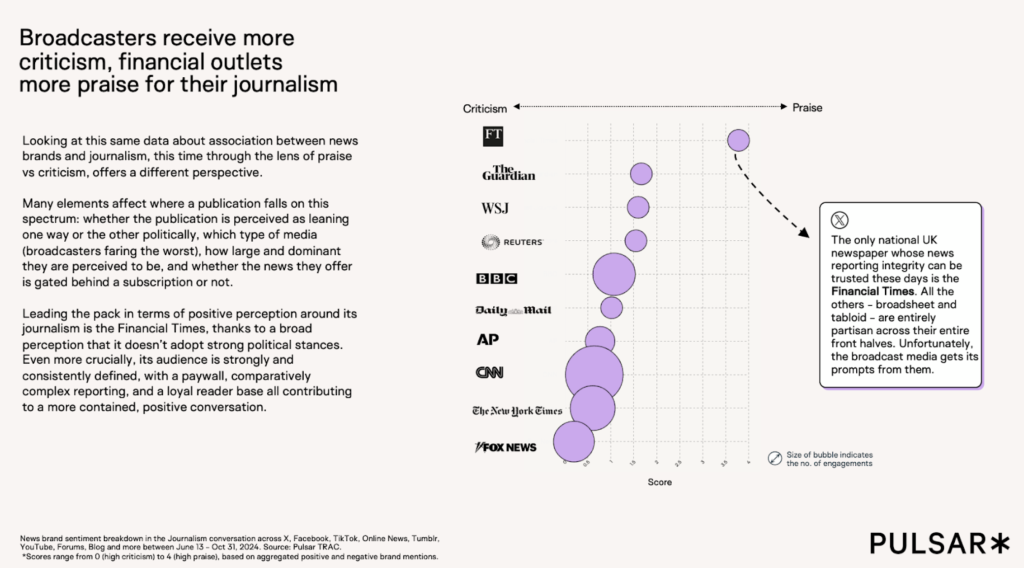
Case Study: Journalism as Brand Equity
Pulsar’s Journalism Brand Equity report mapped how leading news outlets are perceived across political and cultural micro‑communities. The analysis revealed which narratives boosted trust and which eroded it, highlighting opportunities for publishers to reframe coverage and improve engagement without alienating core audiences. This approach allowed newsrooms to measure not just reach, but the quality of their reputation over time—a critical factor in subscriber growth and ad partnerships.
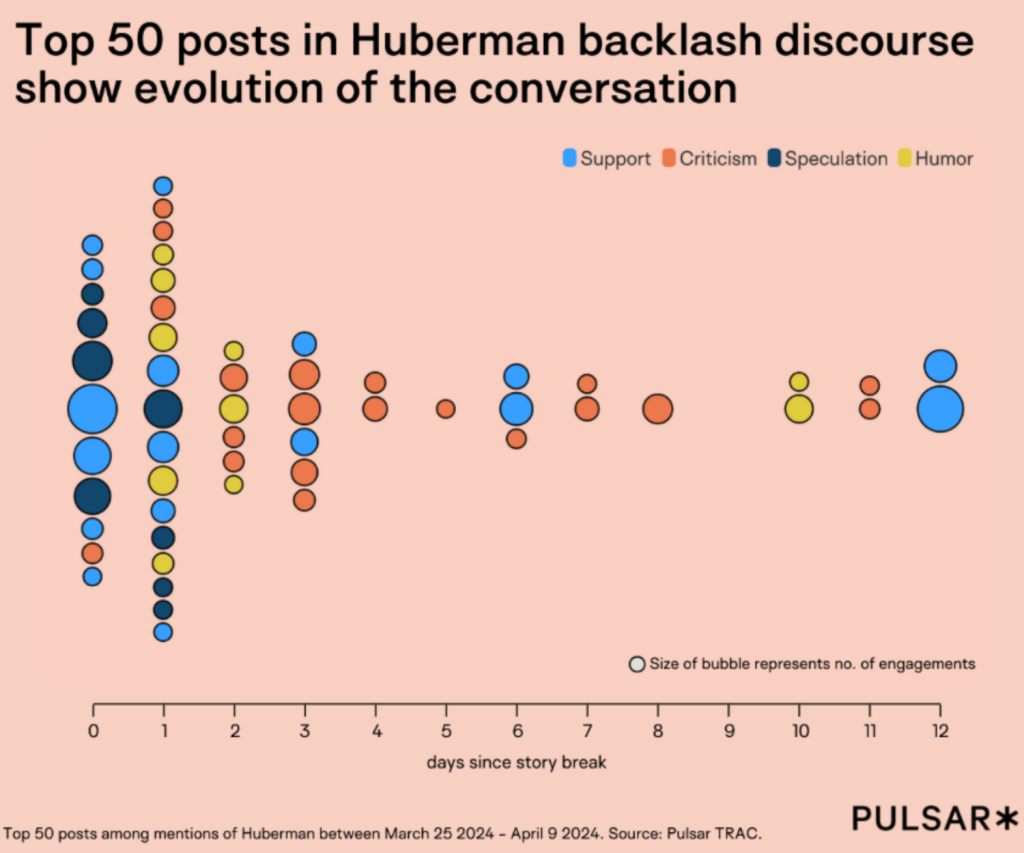
Case Study: Andrew Huberman PR Crisis
When neuroscientist and podcaster Andrew Huberman faced a tabloid scandal about his personal life, Pulsar tracked the narrative’s spread across Twitter, Forums, and YouTube to separate fact from rumor. The analysis revealed that the most viral takes came not from critics but from fans debating his credibility—insight that informed his comms strategy. By addressing the right narratives directly (and ignoring the noise), Huberman preserved audience trust and kept sponsors on board, turning a potential reputation meltdown into a recovery story.
2.4 Power Smarter Campaign & Content Strategies
Successful campaigns aren’t just about reach—they’re about resonance. Pulsar helps entertainment brands pinpoint which communities, platforms, and formats spark the strongest engagement—then optimize creative and media strategies in real time. By tracking share of voice, narrative momentum, and cross‑platform behavior, marketers can move beyond one‑size‑fits‑all messaging to deliver content that truly connects.

Case Study: Netflix Fandom Analysis
Pulsar’s analysis of Netflix fandoms revealed how audiences for hits like Stranger Things and Wednesday fragmented across platforms and generations. Younger fans fueled meme culture on TikTok, while Forums and YouTube hosted long‑form theorycrafting and lore debates. This insight allowed Netflix to tailor its campaigns—deploying snackable content for younger clusters and deep‑dive interviews for older superfans—maximizing cultural traction across the lifecycle of each show.
Case Study: The Rise of Vtubing
Similarly, Pulsar’s study of the rise of Vtubing uncovered how virtual streamers built highly loyal, niche communities that behave more like fandoms than casual viewers. By analyzing the language, rituals, and spending habits of these audiences, entertainment brands can design campaigns that authentically tap into virtual creator culture—informing partnerships, merch strategies, and even new IP development in adjacent spaces like gaming and anime.
2.5 Audience Segmentation and Targeting
Demographics alone won’t explain why one fan memes a show to death while another writes a 5,000‑word in-depth theory on a forum. Pulsar TRAC’s audience segmentation uncovers fandom subcultures, psychographics, and influence patterns—so campaigns speak to people’s passions, not just their age brackets.
Case Study: The Sidemen’s Gen Z Empire
Pulsar analyzed the Sidemen, YouTube’s most influential creator collective, to understand how they transformed from gaming vloggers into a multi‑million‑dollar brand. The segmentation revealed distinct audience clusters—from football obsessives to prank‑video loyalists and merch‑driven superfans—each with unique content preferences and purchase triggers. These insights informed tailored campaigns for Sidemen FC events, clothing drops, and snack product launches, proving how subculture‑level intelligence drives both engagement and conversion.
Case Study: K‑Pop Demon Hunters — Fandom Funnels in Action
Pulsar’s K‑Pop Demon Hunters analysis mapped fandom into layered “funnels”—from Lorecore Fanartists crafting elaborate alternate universes, to BL Storysmiths driving engagement through intricate genre storytelling, to Cross‑Media Enthusiasts who amplified the film across mainstream culture via memes and personal takes. These audiences weren’t just consuming; they acted as distributed marketing engines, fueling the IP’s reach through fan‑driven lore, soundtrack advocacy, and even merchandise hauls that spiked museum gift‑store sales. By identifying which clusters were core vs. casual vs. cultural amplifiers, marketers could prioritize fan‑creator collaborations and tailor product rollouts—bridging music, film, and collectibles into a cohesive strategy.
3. The M&E Professional’s Toolkit — Mastering Audience Intelligence with Pulsar
The entertainment industry no longer runs on gut instinct or delayed ratings reports—it runs on live cultural signals. Audiences fragment across TikTok, Discord, Instagram, and private fandom forums; narratives mutate in real time; and one viral edit can make or break a release.
M&E professionals need an integrated toolkit—something that can zoom all the way into a single fandom conversation, then zoom out to map cultural currents across markets and months. Pulsar provides exactly this dual view:
3.1 The Microscope: Pulsar TRAC for Granular Analysis
Pulsar TRAC delivers real-time, tactical intelligence—ideal for teams tracking campaign performance, monitoring live fan sentiment, or managing crises as they unfold.
What TRAC Offers
- Comprehensive Data Coverage: Tap into TikTok edits, Forum AMAs, Discord chats, YouTube comments, podcasts, and news/broadcast outlets—all in one dashboard.
- Behavioral Segmentation: Move beyond age and location—pinpoint fanfiction writers, meme‑makers, soundtrack evangelists, or cosplay subgroups instantly.
- AI‑Powered Precision: Detect emotional tone, credibility, and engagement patterns using 50+ filters to isolate meaningful signals.
This “microscope” view lets entertainment marketers identify early resonance—like when Bridgerton’s trailer triggered romance‑core edits on TikTok—or detect looming risks, such as the Andrew Huberman controversy, where negative sentiment clusters surfaced days before mainstream media coverage.
3.2 The Telescope: Pulsar Narratives for Big‑Picture Understanding
Where TRAC reveals micro‑movements, Pulsar Narratives maps the larger cultural currents—critical for strategists, executives, and content teams deciding what stories to tell next.
What Narratives Offers
- No‑Boolean Narrative Briefings: Enter any theme (“K‑Pop anime crossovers”) and instantly see top storylines, drivers, detractors, and their evolution across media.
- Macro & Micro Lenses: Track long‑term shifts, like the rise of romance IP, alongside short‑term spikes, like finale buzz or soundtrack drops.
- Public vs. Media Gap Analysis: Compare what audiences are saying vs. how journalists are framing it—crucial for campaigns and reputation strategy.
This “telescope” view revealed, for example, how anime‑inspired aesthetics were migrating into K‑Pop fandom long before brands or media caught on—unlocking crossover merchandising and marketing opportunities. It also exposed how Netflix consistently turns niche interests (like queer romance or fantasy lore) into mainstream cultural hits, guiding investment toward IP with the highest crossover potential.
TRAC vs. Narratives: Two Lenses, One Ecosystem
| Capability | Pulsar TRAC (The Microscope) | Pulsar Narratives (The Telescope) |
| Primary User | Insights Analyst, Marketing Manager, Comms Specialist | Strategist, Researcher, Studio Executive, CMO |
| Core Question | “What’s happening right now? How is our campaign performing?” | “What does this mean? What cultural trends should we anticipate?” |
| Level of Analysis | Granular, Tactical, Real-Time | Big Picture, Strategic, Longitudinal |
| Primary M&E Use Case | Tracking weekly episode buzz, analyzing trailer reception, managing a PR crisis | Validating new genre investment, mapping fandom ecosystems, finding cultural white space |
4. A Practical Framework for Embedding Audience Intelligence
Capturing insights is only half the battle; embedding them into workflows turns data into ROI. Here’s how leading studios and media companies operationalize Pulsar:
Step 1: Set the Strategic Goal
Define whether you’re shaping creative choices, optimizing a campaign, expanding a franchise, or protecting reputation. This could mean identifying soundtrack moments that resonate most (K‑Pop Demon Hunters), timing merch drops around peak meme cycles (Sidemen), or anticipating fan fatigue to plan spinoffs (Bridgerton).
Step 2: Build Multi‑Layered Queries
Combine audience segments (e.g., Lorecore Fanartists, Cross‑Media Amplifiers) with topics (e.g., anime visuals, soundtrack nostalgia) and platforms (TikTok, Tumblr, Discord) to surface multidimensional insights.
Step 3: Visualize Insights in Real Time
Use dashboards to monitor sentiment swings, share of voice, and narrative overlaps—vital during trailer releases, live events, or unexpected fan‑led campaigns.
Step 4: Act on Findings
Shift creative focus to emphasize fan‑favorite elements, retarget ad spend toward high‑engagement segments, or adjust PR tone in response to cultural resonance.
Step 5: Learn and Refine
Feed insights back into development and marketing pipelines, ensuring each new season, trailer, or product drop builds on the last.
Conclusion: Audience‑Driven Leadership
The winners in entertainment aren’t just producing content; they’re co‑creating culture with their audiences. Pulsar’s dual‑lens approach—micro (TRAC) and macro (Narratives)—empowers M&E teams to stay ahead of fan behavior, cultural shifts, and reputational risks.
With this intelligence, studios can:
- Greenlight with cultural confidence.
- Launch with fan‑first relevance.
- Franchise with momentum that lasts beyond opening weekend.
To stay ahead of shifting media & entertainment narratives and evolving audience behaviors, subscribe to our newsletter.