Am I part of the Permanent Underclass now? Or just an NPC?

Welcome to the permanent underclass, comrade. And don’t mind the gnawing existential dread, we’ve got all sorts of slop for that.
The idea of a ‘permanent underclass’ is easy enough to understand. For one thing, you’ll recognise it when you see it. And you’ll certainly recognise it when you’re in it.
But as meanings and points of reference collapse in on themselves, it seems that those talking about a permanent underclass are increasingly talking about different things.
In the “countryside” getting swarmed by bugs because my phone emitting light as I read posts about how I won’t escape the permanent underclass
— dasha (@dash_eats) June 13, 2026
A quick pencil sketch of the concept as it’s commonly understood: with the coming AI wave, meritocracy and social mobility will disappear, and the world will be divided between those with control of this technology, and the rest.
If that sounds familiar, it’s because there’s more than a suggestion of Marx’s means of production in there, with a crucial caveat. The idea is not to dismantle the system, but rather to ascend to the higher tier before it’s too late.
And that’s been plenty enough to compel a new generation of founders and technologists to work a 996 schedule (9am-9pm, 6 days a week). The Valley is no longer somewhere you escape to, but rather a staging post in the process of escaping the centrifugal forces that will sling the rest of us into the mud.
Economists have already debated the concept on its merits. That’s not what I’m going to be exploring here. Instead, I wanted to examine how the idea has intersected with culture in different ways, and helped condition the public response to a host of different topics.
To do that, I ran my hypotheses through Saga, Pulsar'a autonomous research agent. This helped map all social media conversations taking place around the idea, and clustered them from the bottom up (so I couldn’t lock into the data that served my points and ignore the rest).
The phrase escaped Valley containment when Kyle Chayka wrote an article explaining this new tech-bro obsession in The New Yorker. Until that point, it had cropped up in disparate forums and threads as a useful shorthand for discussing inequality, but had never achieved significant velocity, and wasn’t explicitly tied to AI.
But technologists and business leaders in the Valley had, over 2025, clearly begun employing the phrase as a means of discussing the impact AI would have on world economies, in conversation, in internal emails, and in the group chats that now so notoriously run the world. Chayka’s article surfaced this trend, and ascribed much of the theoretical underpinning to an essay by Leopold Aschenbrenner, the wunderkind investor and onetime OpenAI researcher, who has the look of a minor Habsburg about to lead your regiment into direct cannon fire. ‘Models will be able to do the work of an AI researcher/engineer,’ he stated, and his audience were quick to agree with him.
Aschenbrenner became a personification of the concept of the ‘permanent underclass’, despite never appearing to actually use the phrase on any public forum: its prophet and a shining example of someone who was emphatically not in it.
If you’re reading this you’re in the permanent underclass (not at Leopold’s wedding)
— Miles Brundage (@Miles_Brundage) August 1, 2026
Of course, if you’ve been following AI-related news recently, you’ll have seen that Aschenbrenner is currently being gleefully lambasted for his Situational Awareness fund taking a multi-billion-dollar haircut.
The thing is, audiences aren’t using this latest news to question the legitimacy of an idea Aschenbrenner was seen to embody. Instead, most critiques revolve around his usage of leverage to expand holdings in AI – and how this makes holding onto positions during a pronounced downturn (falling Korean tech stock, commoditisation of lower-end models, etc) practically impossible.
Well, most critiques, anyway.
Welcome back to the permanent underclass https://t.co/PXLeyAZTYA
— Ken Wattana (@KenWattana) July 30, 2026
Clearly, then, the phrase is unmoored from any one figure. It has evolved beyond its initial Valley usage, and its subsequent framing in Chayka’s article. So where does that leave us?
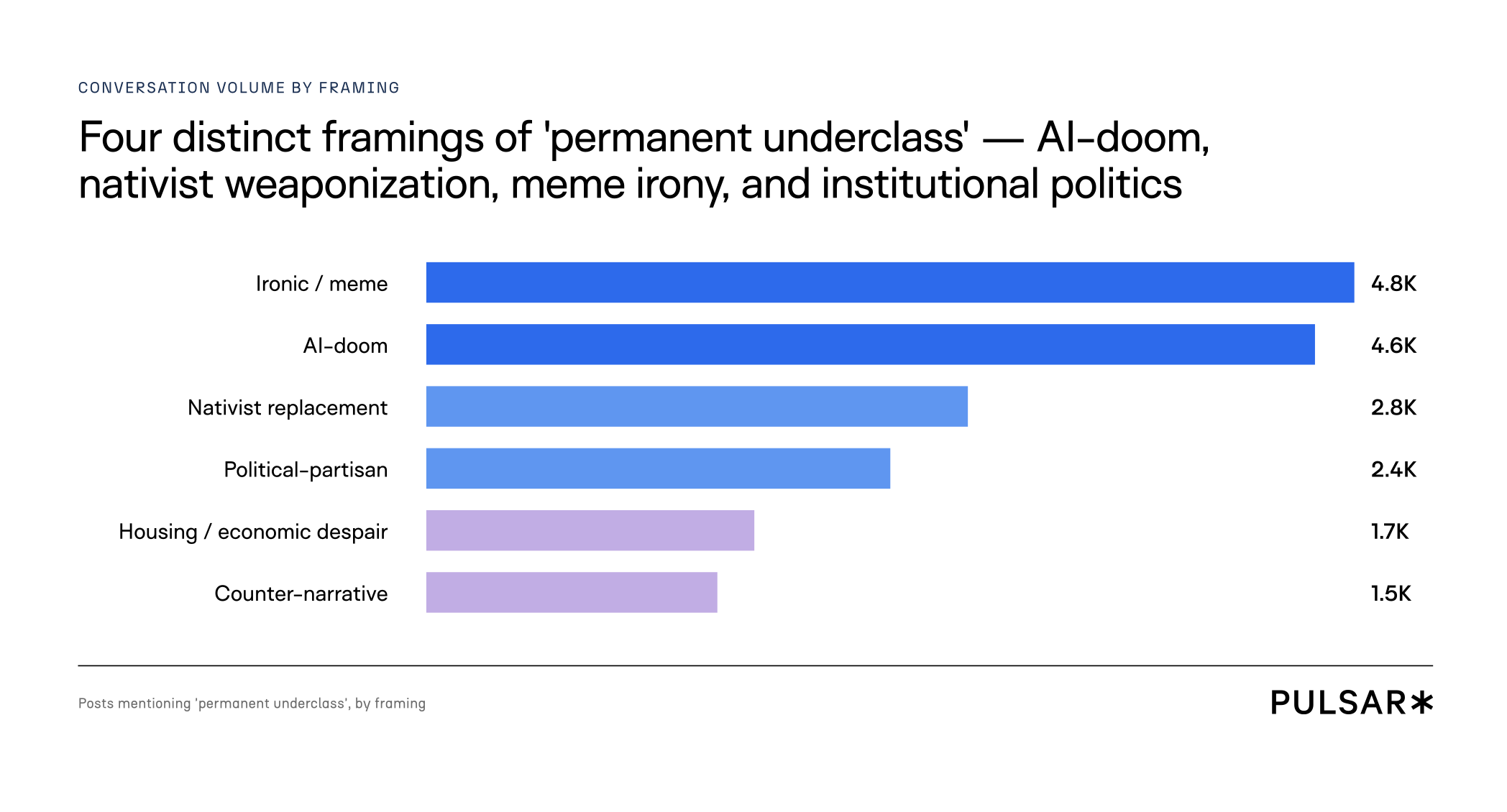
Saga surfaced several distinct conversational clusters; let’s organise these into three distinct macro-categories categories, and take them in turn.
Everything is fucked
Eponyms flock to ‘Permanent Underclass’ like moths to flame. Or flies to excrement, if you’re inclined to cast a more jaundiced eye on the whole thing. At once Gibsonian, Huxleyan, and plenty more -esques, -ians, and -ites besides, it’s a useful tool for anyone communicating some variant of ‘things are very, very bad actually’.
Some of this is institutional. Senator Elizabeth Warren authored the most engaged-with post taking this angle…
Tech execs are saying AI will create a "permanent underclass."
Not on my watch. We need to:
Close loopholes rewarding AI over workers.
Wealth tax—CEOs shouldn't pay a lower rate than workers.
Tax AI data centers.
AI's success belongs to everyone.
— Elizabeth Warren (@ewarren) June 3, 2026
… even if, in a sign of how lines of communication and amplification have changed, it was prediction market Polymarket that was more responsible for projecting her messaging than her own, official account (or any traditional news media).
JUST IN: Senator Elizabeth Warren urgently calls for AI regulations to prevent a “permanent underclass”
— Polymarket (@Polymarket) May 27, 2026
Warren is also the second-most recurrent entity to appear, after Anthropic.
The company behind Claude accounts for nearly 26% of all corporate/person entity volume. The recurrence of keywords ‘fable’ (972) and ‘frontier’ (594) show the discourse is specifically about frontier AI models and their societal implications.
@prestonrho the permanent underclass #ai #claude #unemployed #techtok #blowthisup ♬ original sound - prestonrhodes
Anthropic, however, are not a corporate target because they are seen as particularly unethical: they are simply viewed as the best, and most efficient producer of models in the aggregate, and therefore the company at the vanguard of worker displacement.
Anthropic stands clear of all other corporate entities. And the next most mentioned brand is not OpenAI, or DeepMind, or any other brand that builds models, but rather Nvidia.
But there's a key distinction in how Nvidia are discussed – not as a company producing products, but as a wealth machine whose employee equity gains are the visible proof of AI-driven class stratification.
So far, so expected perhaps. But it’s in this doomer category that we also see the first cultural zag.
Because the same framing applied to the job market is also applied to the housing market, losing the AI-specificity but retaining the sense of disempowerment.
One thing becoming increasingly clear
If you didn’t lock in your 30 year mortgage at a sub 3% rate before 2022, you missed out on ever building home equity
Permanent underclass forever https://t.co/aIUJIyCVHG
— Boring_Business (@BoringBiz_) May 19, 2026
This framing is the most negative, even more so than ‘AI models are disempowering people’ because it presents zero chance of escape or mitigation. The ladder has been pulled up; there might as well never have been a ladder.
In this way AI anxiety is connected to broader economic precarity. The discontent around housing long predated agentic AI’s breakout moment, but this new phraseology provides a fresh vector for those arguments.
Nouveau NPCs
Here is where ‘permanent underclass’ most clearly parallels NPCs.
every so often I read an offhand comment like "granted, cnc orgies ARE a crucial networking opportunity in the bay area..." and I realize I'm actually very comfortable in the permanent underclass, thank you
— 𝕙𝕠𝕡𝕖𝕗𝕦𝕝 𝕒𝕓𝕒𝕟𝕕𝕠𝕟 (@OstavNadezhdu) June 3, 2026
In each instance, both barrels of a dehumanising, debasing phrase are turned on the subject for maximum effect. Clearly, that guy hanging around my local supermarket is not actually an NPC. Clearly, I do not genuinely feel myself to be part of the permanent underclass. But it’s the kind of sledgehammer-with-a-nut-type exaggeration that’s shot through the internet: everything from ‘this movie makes me want to tear my fucking eyes out’ to ‘literally sick with excitement’ all the way back to LMFAO or ROFL.
Your actual arse? You were rolling? On the floor?
There’s a whole subset of humour here that revolves around the particular phrase ‘Welcome to the permanent underclass’.
2026 will be your year.
2027 welcome to the permanent underclass— atlas (@creatine_cycle) December 31, 2025
In fact, I was even going to make that the title of this article before realising that every other NPC to write about the topic had the same idea.
Ultimately, there’s a reason why posters return to this theme. In part, that’s just because it’s a winning formula on socials; we should be careful not to over-intellectualise every aspect of this. But it also speaks to a deeper psychic need. The joke is told because the speaker is demonstrating the very awareness that disproves membership.
And that, in turn, speaks to a broader truth. For now, at least, you cannot designate someone else part of the permanent underclass. That’s where it markedly differs from the NPC usage.
An NPC is what you call someone else. You do not call someone else a part of the permanent underclass. Perhaps someone will, and that stigma will break. But I doubt it. For while the former is cutting, but ultimately absurd, the latter encroaches too closely on real concerns, and real economic context.
Push to exit
It wouldn’t be the internet if someone weren’t trying to sell you something on the back of this.
The permanent underclass narrative has been adopted wholesale by crypto communities: “there’s still no better ecosystem on the planet to be a part of if your dream is to escape the permanent underclass”, etc.
On the one hand, it’s tempting not to give these shysters more than a moment’s thought. On the other, we can recall the old adage that sex workers, due to their need for safety and utility, are often amongst the first users of payments, comms or financial tech that has staying power. By that same token, crypto shills are especially attuned to the emotional anchors that part people from their money. They might not have anything interesting to say about the ‘permanent underclass’, but the very fact of their attention is notable – and only serves to disseminate the idea further.
More relevant is the thread of thought that brings us full circle back to AI doomerism, and the response to labs releasing new models: “Drop what you’re doing. Opus 4.8 is out... This is what you need to do immediately if you want to escape the permanent underclass.”
Perhaps, this view suggests, the same AI tools that appear to be locking most of society in place, might be just the thing to deposit me at a higher rung than I might have been able to achieve in the pre-AI world.
For the true parallel here, we should look back to something more resolutely analogue: the racecourse tipster, whose whole deal was not making bets himself, but rather selling his thoughts on which bets you should make. How could this possibly be anything other than a very roundabout way to make less money than he might have expected to make following his own advice?
For the tipsters, the economics of it all were canny. Tipping different horses to different customers guaranteed winnings for at least some of the clientele, and those were the ones who would return, bringing their friends along.
In much the same way, the figures who talk up the value of their own productivity tools, or their own expertise as navigating frontier models, are attempting to sound right enough times to enough people – either to ascend another rung on their own journey out of the underclass, or simply to capitalise on an audience who could ever have believed such an idea in the first place.
To stay up to date with our latest insights and releases, sign up to our newsletter below: