Brand Reputation for Celebrities: The 2026 Forecast
- Agencies

At the 2026 Golden Globes, Nikki Glaser described celebrities as the popular kids at school — figures who "unite us - it makes the nation feel like high school again." Her observation captures why celebrity culture continues to command attention. It also explains why reputation risk has never been higher.
In 2026, celebrity brand reputation is shaped by trust and relationship, not visibility. Fame amplifies scrutiny as audiences actively evaluate credibility, values, and behaviour in real time. Through social listening, audience intelligence, and narrative intelligence, these judgments can be tracked as they form across TikTok, forums, podcasts, news media, and private social spaces simultaneously. Reputation is no longer managed through messaging alone. It emerges from the narratives audiences construct over time, rewarding behavioural consistency and rapidly exposing contradiction.
Contents:
- Introduction
- 1. Using Audience Intelligence to Manage Celebrity Brand Reputation
- 2. Reputation by Association: How Everyday Brands Humanize Celebrity Power
- 3. Narrative Arbitrage: Mastering the Gap Between Media and the Public
- 4. The AI Backlash and the "Human-Made" Premium
- 5. From Influencer to Authority: Why Trust Defines Celebrity Brands in 2026
- 6. Podcast Primacy: The Trust Economy’s Heavyweights
- Conclusion
Introduction
Our analysis shows that reputation is no longer managed reactively. It is actively built through systems. Podcasts function as trust infrastructure. Unexpected partnerships humanize celebrity power. Narrative alignment determines whether crises escalate or stabilize. AI acceleration introduces new reputational risk when the human voice disappears.
Platforms such as Pulsar TRAC, Pulsar Narratives AI, and Pulsar CORE allow brands to move beyond lagging indicators like surveys or sentiment scores. Using real-time behavioral signals, we can detect belief-level shifts, narrative escalation, and reputational fragility before they surface as headlines or revenue loss.
This forecast examines the forces shaping celebrity brand reputation in 2026. Using social data and narrative intelligence, we map how authority is built, how trust transfers, and how reputations endure under pressure.
1. Using Audience Intelligence to Manage Celebrity Brand Reputation
Celebrity brand reputation is no longer shaped by isolated incidents or press cycles. It is shaped by how narratives form, spread, and stabilize across audience ecosystems. Audience intelligence provides the infrastructure to monitor these dynamics continuously, allowing reputation to be managed proactively rather than reactively.
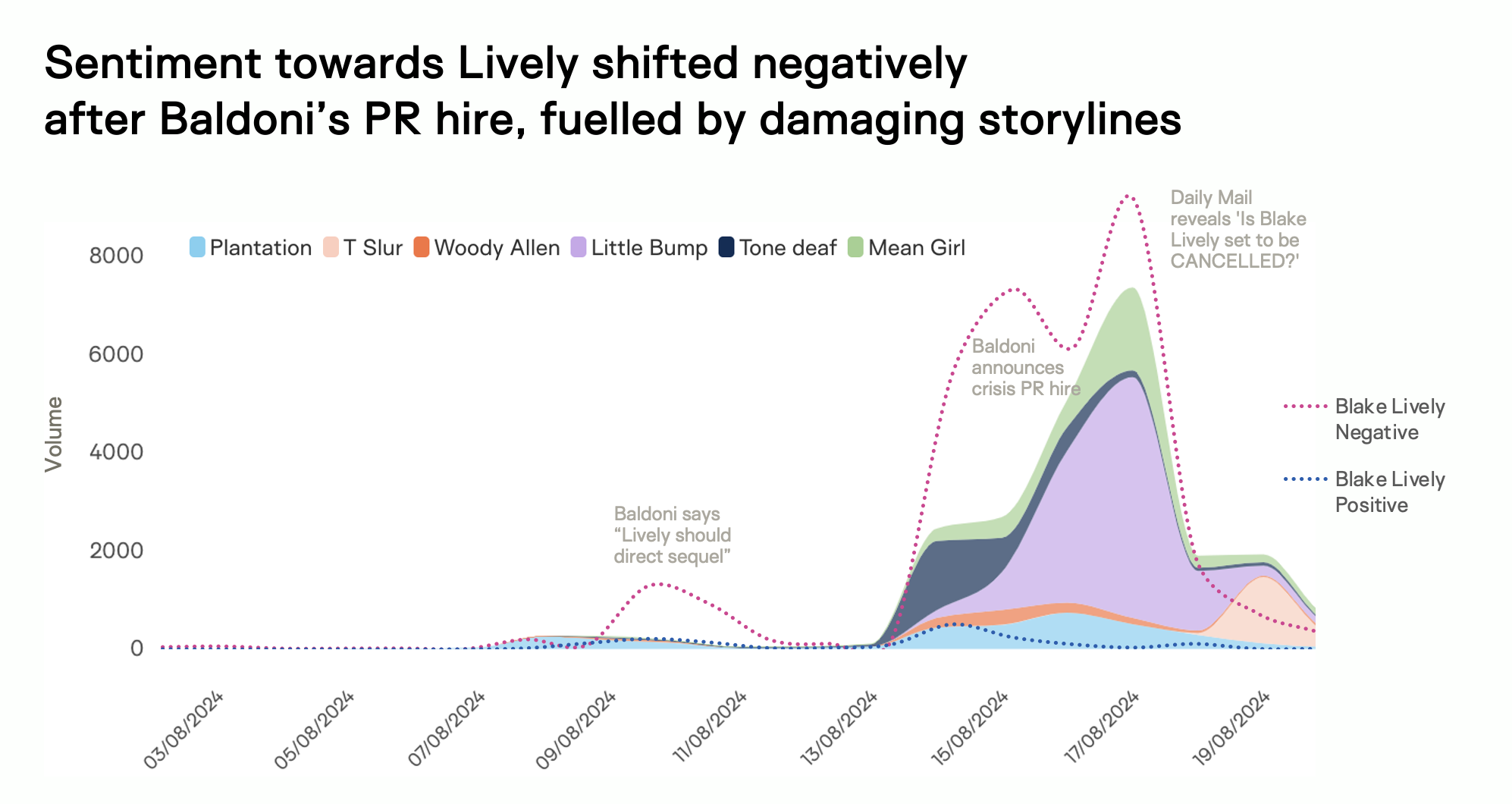
The Blake Lively–Justin Baldoni conversation demonstrates how this works in practice. In August 2024, speculation about a rift surfaced on TikTok and forums. Overall conversation volume remained limited, but audience intelligence surfaced an early reputational risk: negative descriptors about Lively were clustering within high-engagement communities before mainstream media attention followed. This is a critical use case. Brand reputation damage begins when narratives consolidate inside influential audience segments, not when sentiment spikes publicly.
As these themes moved from social platforms into tabloid coverage, particularly via the Daily Mail, audience intelligence made the amplification pathway visible. It showed how niche narratives acquired legitimacy and scale once picked up by established media, and how reputational attention shifted between individuals. This type of insight allows celebrity teams to understand where reputation is being shaped and which narratives are likely to harden if left unaddressed.
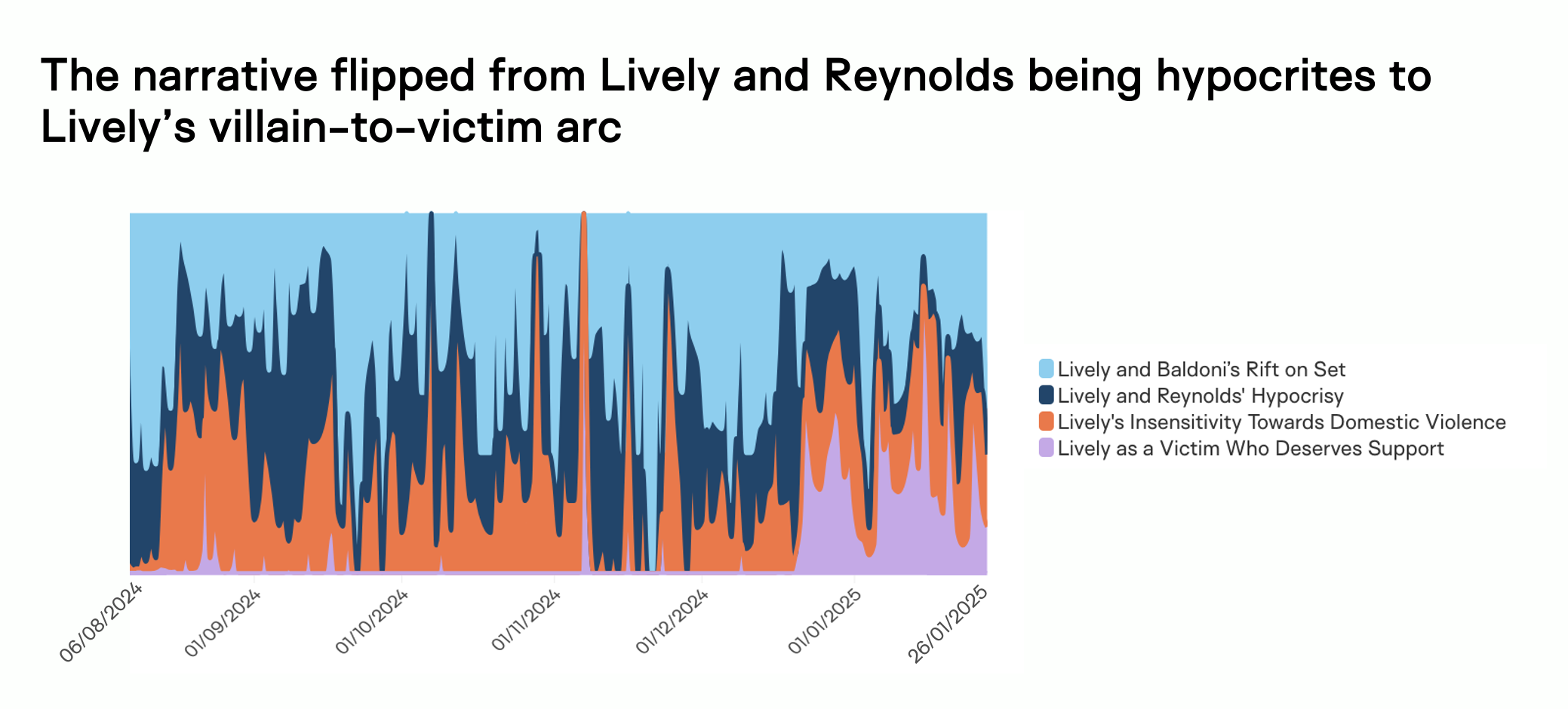
In December 2024, legal action and investigative reporting triggered a narrative reversal. Audience intelligence captured a belief-level shift, as conversation moved from personality-based critique to ethical evaluation and power dynamics. This distinction matters for brand reputation. Once audiences begin assessing integrity rather than image, reputational risk becomes more durable and harder to correct through surface-level messaging.
Further legal developments and the release of raw footage in January 2025 did not restore narrative stability. Instead, they fragmented perception across audience segments. Audience intelligence revealed that different communities stabilized around different interpretations, reinforcing the reality that celebrity reputation no longer resolves into a single public truth.
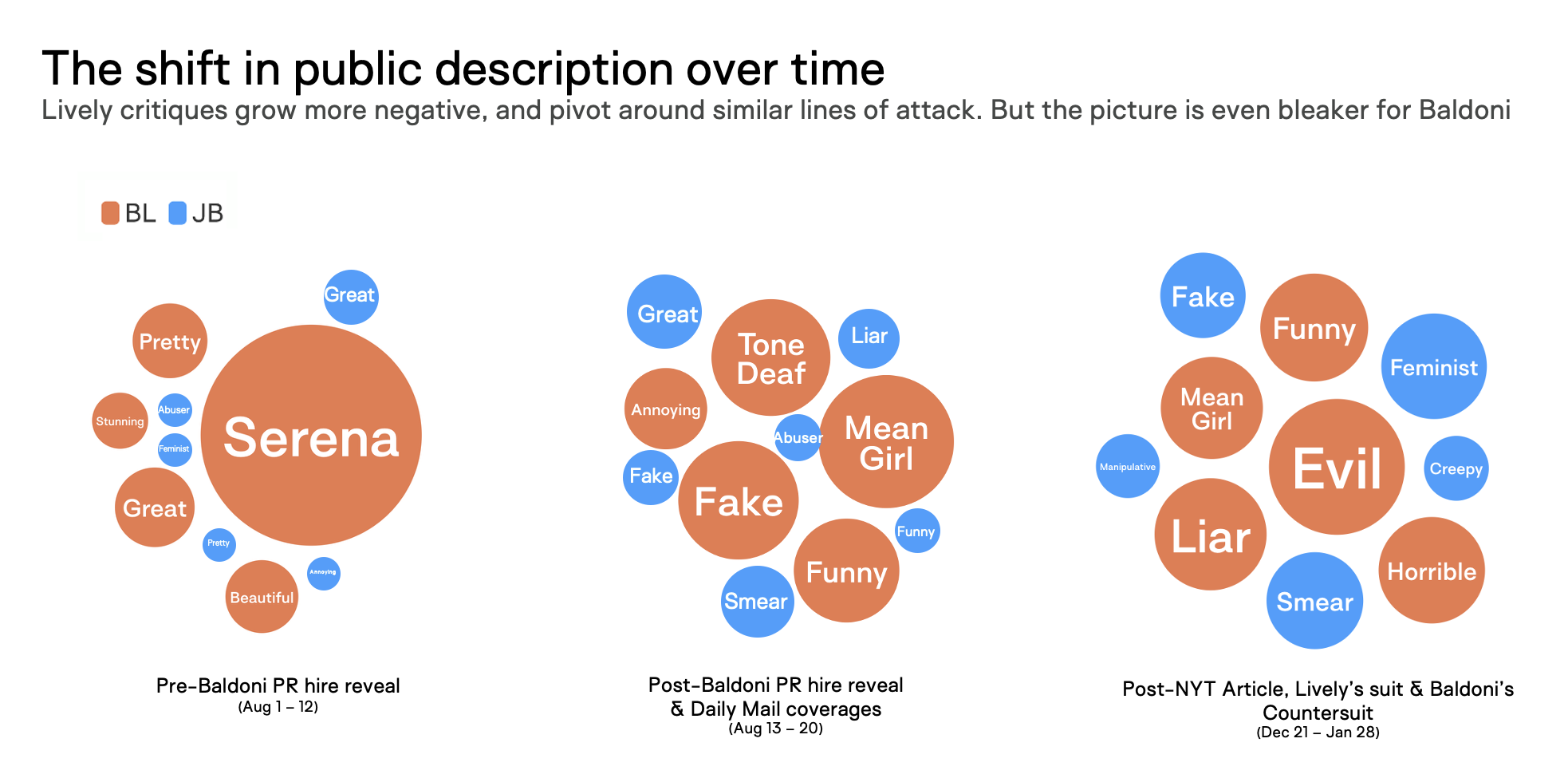
The implication for celebrity brand reputation is clear. Audience intelligence enables teams to identify early narrative risk, track how credibility is forming or eroding across audiences, and recognize when perception has shifted from criticism to distrust. In a fragmented media environment, reputation is managed by understanding which audiences believe what, and why, long before those beliefs solidify into consensus.
2. Reputation by Association: How Everyday Brands Humanize Celebrity Power
By 2026, celebrity brand reputation will be shaped less by category fit and more by symbolic contrast. Traditional endorsement models prioritized apparel, luxury, and performance equipment as safe extensions of status. Our analysis shows this hierarchy is weakening. The most effective partnerships now feel unexpected but culturally coherent.
Coco Gauff’s partnership with Barilla illustrates this shift. Placing a household pasta brand on one of tennis’s most elite stages disrupted sponsorship norms. Crucially, it did not dilute Gauff’s reputation. Our social listening analysis shows the opposite. The partnership expanded her brand from elite athlete to lifestyle symbol grounded in routine, nourishment, and everyday discipline.
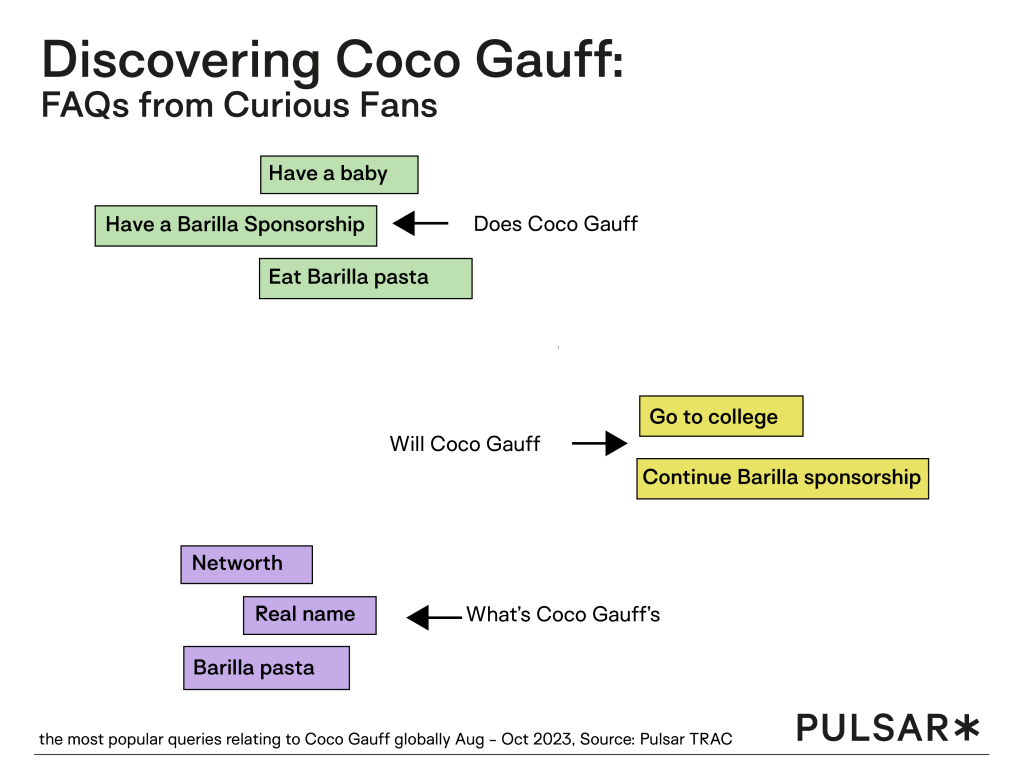
Using Pulsar TRAC, we observed that audience response focused less on product placement and more on values alignment. Audiences interpreted the partnership as authentic rather than commercial. Gauff’s reputation benefited because the brand reinforced existing narratives of balance, maturity, and self-control. Household brands can function as reputational stabilizers when values align.
This matters for celebrities navigating fragmented attention environments. Our data shows audiences are increasingly interested in personal values, habits, and lifestyle signals, not professional achievement alone. Iconoclastic partnerships allow celebrities to humanize their public image without sacrificing authority. They reduce distance while preserving credibility.
Gauff’s Audience Affinities: Tracking Reputational Return
Narrative mapping of the Gauff–Barilla partnership revealed overlapping belief systems rather than isolated fan groups:
- Business-driven Italiophiles engaging with premium lifestyle and performance narratives.
- Millennial R&B fans seeking cultural authenticity across sport, music, and identity.
Elite athlete followers prioritizing health, agency, and nutrition framed as fuel.
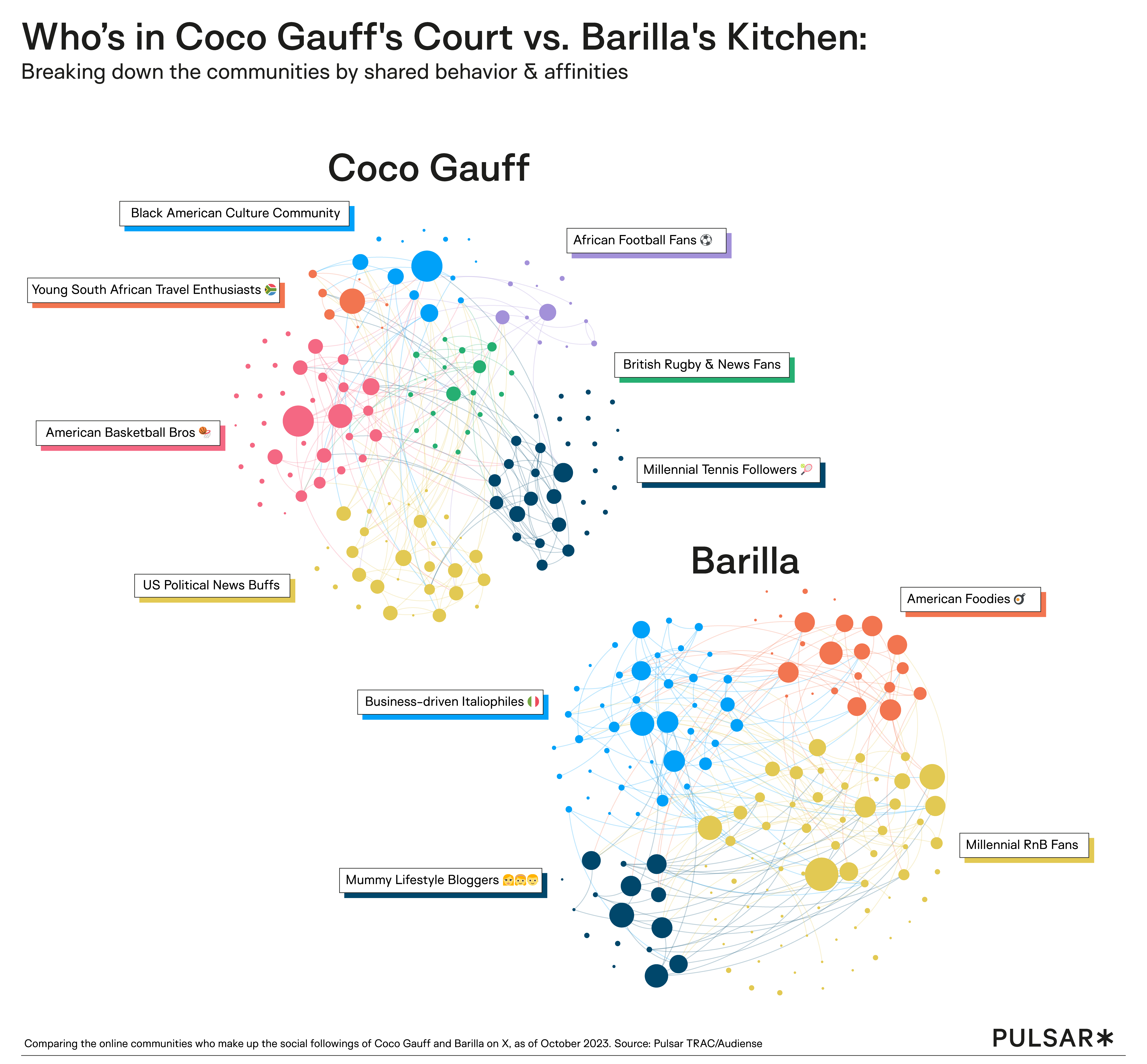
These overlaps explain reputational lift. Celebrity brands now operate across intersecting audience ecosystems. Partnerships succeed when they activate shared beliefs rather than shared categories.
The implication for 2026 is clear. Brand and talent teams must prioritize person–brand alignment using audience behavior, not industry convention. Iconoclastic partnerships help celebrities counter negative tropes and future-proof reputation. Household brands, when carefully chosen, reposition fame as grounded, disciplined, and credible.
In 2026, the least obvious partnerships may deliver the greatest reputational return.
3. Narrative Arbitrage: Mastering the Gap Between Media and the Public
A critical skill for celebrity reputation management in 2026 will be "Narrative Arbitrage"—the ability to identify and exploit the gap between "Media Narratives" and "Public Narratives". What the press says and what the public says are often misaligned. For celebrities, a crisis can be amplified by a defensive media response that misses the "cultural seed" of public anxiety.
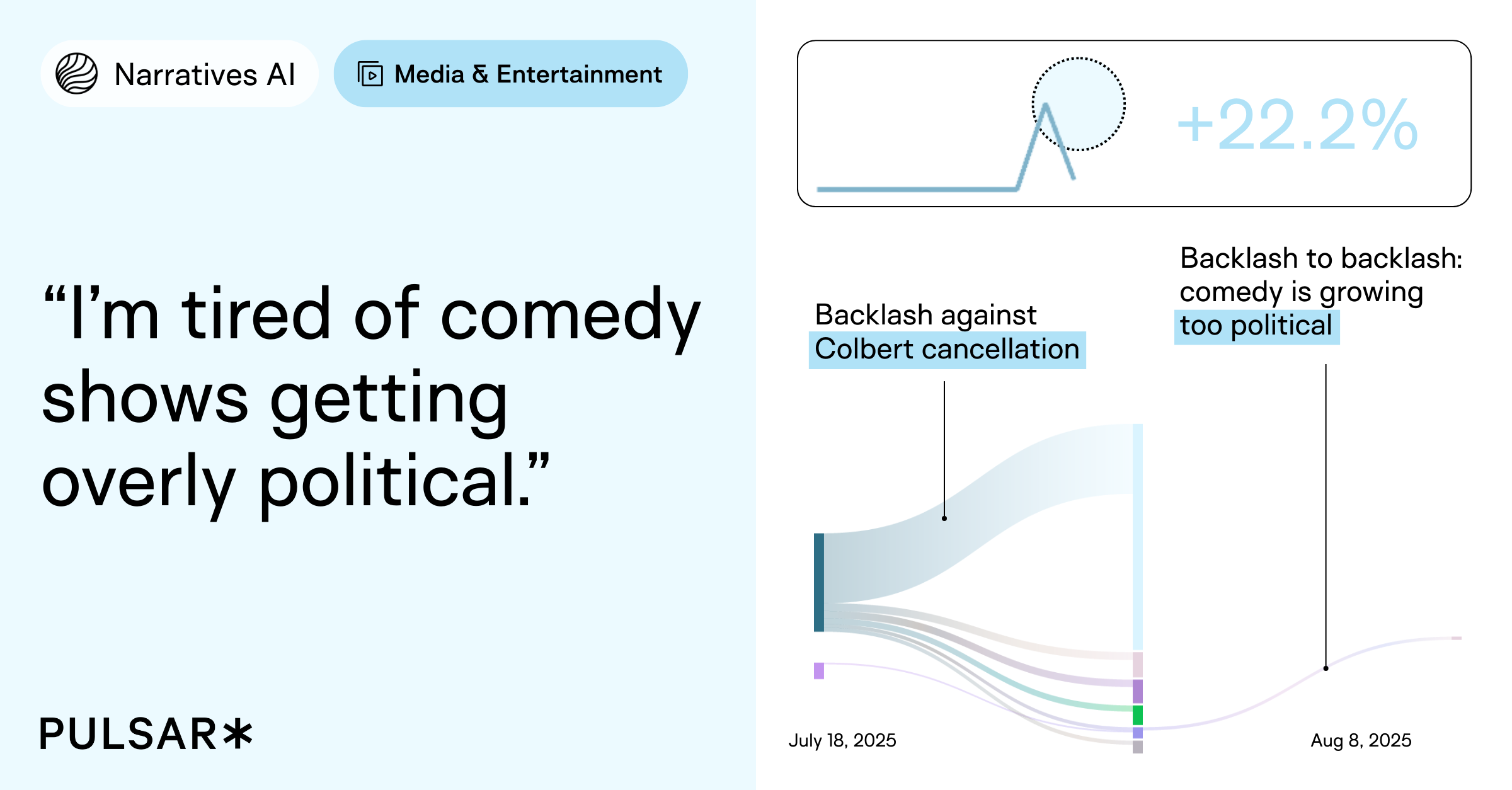
Tools like Pulsar Narratives now cluster billions of posts to reveal these hidden forces. While the news media might emphasize a celebrity’s financial performance, public conversation may center on their environmental impact or personal integrity.
The 2026 Narrative Landscape
- Media Narrative: Controlled by traditional outlets; often focused on structured data, financials, or traditional scandals.
- Public Narrative: Decentralized across social media and dark social; emotional, niche-driven, and highly reactive.
- Synthetic Narrative: AI-generated or bot-scaled content capable of spreading misinformation faster than facts.
We were joined in our Narrative Intelligence webinar series by Michael Brito, Global Head of Data + Intelligence at Zeno Group, who explained the importance of using Narrative Intelligence alongside traditional social listening, as well as the difference between media and public narratives.
To watch the full webinar, head to our YouTube channel.
By mapping these narratives in real time, celebrities can decide the "best entry point" to join a conversation and say something useful. In 2026, the implication is that "silence costs". Strategists must detect "weak signals" in niche corners of the internet—such as forums or Discord—before they evolve into mainstream headlines.
4. The AI Backlash and the "Human-Made" Premium
As AI-generated content becomes more pervasive, 2026 is set to see a fierce public backlash. Experts predict AI will become an ick with consumers celebrating the ability to toggle off AI content and seeking "human-made" as a badge of honor. Low-effort, high-volume output increasingly dismissed by audiences as “AI slop” has become shorthand for content that prioritizes scale over meaning. For celebrities and public figures, this introduces a clear reputational risk. AI visibility now erodes trust faster than it builds reach.
ai generated commercial about going to mcdonalds because the holidays are inconvenient to you all seems too on the nose, I'd put the team behind this in jail https://t.co/OwSwDQpROc
— JoeLongBalls (@JoeLongBalls) December 8, 2025
Social listening reveals deep skepticism toward digital perfection. High-profile backlash against AI-generated advertising, including the McDonald’s AI-created Christmas 2025 campaign in the Netherlands, which was then subsequently pulled, demonstrates how quickly audiences reject content they perceive as emotionally hollow or soulless. Recent debates over AI-generated models in major publications suggest that consumers crave "micro-moment authenticity"—unfiltered, unscripted interactions that AI cannot replicate. When celebrities adopt AI-generated visuals, videos, or scripted messaging, audiences question authorship, effort, and authenticity.
there's something about Stephen Mulhern posting AI slop that feels 100000x more dystopian and like a harbinger of full societal collapse than all those unknown techbros and wannabe influencers posting it https://t.co/BU85I3DD45
— Cuz (@HeIsTheCuz) December 17, 2025
In late 2025, UK TV presenter Stephen Mulhern faced online criticism after posting an AI-generated Christmas video, with portions of the audience dismissing the clip as low-quality “AI slop” and questioning its creative value. Users on platforms such as X criticized the video’s synthetic feel and expressed fatigue with machine-generated content that appears to replace human effort and personality. This reflects a broader backlash against imperfect AI media, where audiences increasingly penalize synthetic work that lacks emotional presence and craftsmanship — a trend also seen in high-profile commercial examples of AI ads being pulled after negative public reaction.
For celebrity brands, the implication is clear. AI-generated content is no longer reputationally invisible. It shapes perceptions of effort, care, and credibility. Audiences increasingly crave “micro-moment authenticity”: unfiltered reactions, unscripted speech, and visible human imperfection. These signals reinforce trust in ways AI cannot convincingly replicate.
AI can scale output, but it cannot carry a celebrity’s reputation. In 2026, the celebrities who protect trust will treat AI as invisible infrastructure rather than visible authorship. Cultural meaning, emotional connection, and voice must remain human. In an AI-saturated media environment, reputation will increasingly hinge on who is seen to still be present.
5. From Influencer to Authority: Why Trust Defines Celebrity Brands in 2026
Looking ahead to 2026, the "influencer" label is expected to be less seismically important than the "Guru" or "Life-Architect." Consumers are no longer seeking mere product recommendations; they crave "agency and self-belief" to change their lifestyles. This shift is exemplified by the resilience of high-profile figures who maintain their brands despite intense scrutiny because they have established a "guru-like personality and authority" that transcends their immediate expertise.
Social listening data from Pulsar Narratives reveals that this authority creates a "lifestyle ecosystem" where advice is framed as a "goldmine" provided for free. This builds an emotional connection that allows sponsors to be folded naturally into a shared lifestyle. In 2026, celebrities who sell a philosophy of living will likely outperform those who simply sell products.
Case Study: Andrew Huberman and Celebrity Brand Reputation Under Pressure
Andrew Huberman shows how authority can both protect and expose a celebrity brand. At scale, his reputation operated as a self-reinforcing lifestyle system. Scientific credibility, long-form podcasting, and carefully aligned sponsors strengthened one another. When the 2024 crisis broke, our social listening analysis showed that this authority initially acted as insulation. Early audience narratives separated personal behavior from the value of his advice. Trust slowed its decline.
As conversations spread across online news, forums, and podcast communities, narratives shifted. Using narrative intelligence, we tracked movement from curiosity to moral evaluation. The central question changed from “Does this affect the advice?” to “Can this person still be trusted?” This transition is critical for 2026. Celebrity brand reputation does not collapse at the point of exposure. It erodes when audience belief systems destabilize.
Importantly, backlash did not center on sponsorship or monetization. It centered on perceived hypocrisy. Huberman’s brand promise was discipline, optimization, and control. Audience narratives turned when behavior appeared misaligned with that promise. For guru-style celebrities, reputation is governed by narrative coherence. Message, conduct, and audience expectation must remain aligned.
Why Social Listening Is Core to Celebrity Reputation in 2026
Our analysis shows that reputational inflection points rarely originate on high-reach platforms. They emerge in long-form discussion spaces where highly invested audiences negotiate meaning. These communities shape dominant narratives before mainstream coverage peaks. By the time reactive PR responses appear, narratives have already stabilized. Sentiment tracking alone is insufficient.
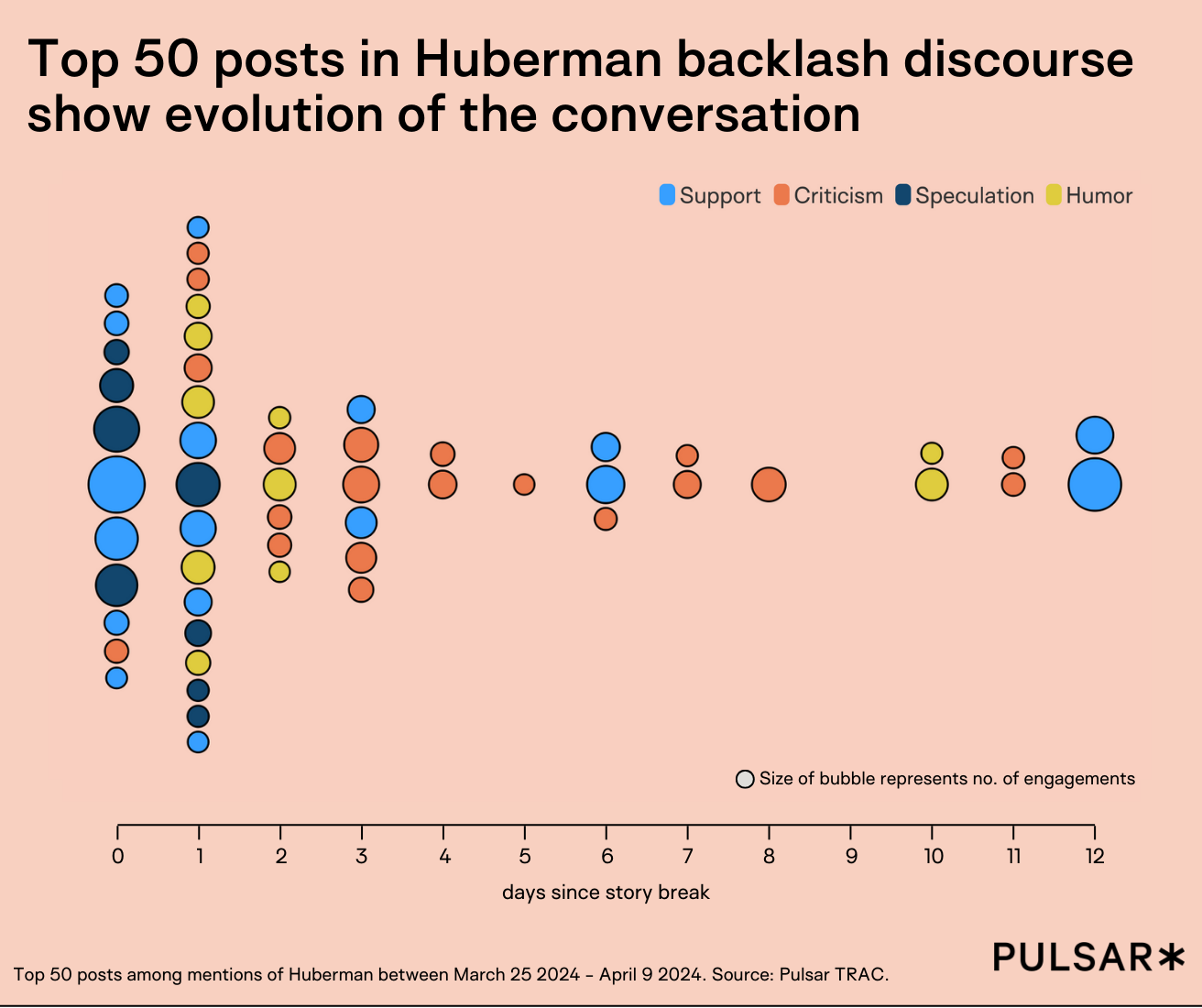
In 2026, social listening functions as early-warning infrastructure. It allows us to detect belief-level shifts inside core audience ecosystems. In the Huberman case, narrative intelligence identified the moment authority shifted into conditional trust. That moment defines whether reputation can be rebuilt or continues to decay.
This has direct implications for sponsors. Our research into podcast advertising shows that host-read endorsements work because trust transfers from the host to the product. When trust fractures, risk transfers as well. In 2026, brands will assess celebrity partnerships through narrative stability, not reach. Social listening enables us to see whether authority is compounding or quietly eroding beneath the surface.
6. Podcast Primacy: The Trust Economy’s Heavyweights
Keeping on the theme of Adnrew Huberman, let’s turn our attention to podcasts as a tool for celebrities to utilize for brand reputation in 2026. Podcast hosts are expected to continue "crushing" social media influencers in the battle for audience trust through 2026. This is a huge area for celebrities to invest in in 2026 as the battle for audience trust continues to determine healthy brand reputation - plus adding a layer of armor against potential brand crisis for celebrities. So for celebrities, podcasts offer scale, intimacy, and strategic protection. They build trust while also creating resilience in the face of reputational risk.
The intimacy of long-form audio creates a "Trust Economy" where hosts are perceived as significantly more genuine than creators on other platforms, driven by extended attention, para-social connection, and perceived intellectual labor. Podcast advertising spend is projected to exceed £2.55 billion in the UK and $4.2 billion globally by 2026 . This sustained growth reflects more than media inflation. It reflects belief.
In our study of podcast advertising, data from Pulsar TRAC shows that podcasting enables personalities to establish authoritative “guru status.” Figures such as Alastair Campbell and Alexandra Cooper demonstrate how podcasts allow celebrities to dominate either high-level political discourse or online tabloid ecosystems. In both cases, the podcast acts as a narrative anchor. It defines tone, values, and legitimacy long before conversation spills into faster, less controlled platforms.
Data Snapshot: The Podcast Trust Advantage
- Consumer Preference: 56% of weekly podcast consumers say host influence matters most to them, compared to 20% for social media influencers.
- Genuineness Factor: Podcast hosts are perceived as 28% more genuine than creators on other platforms.
- Trust Gap: 68% of listeners trust host recommendations, nearly matching the trust levels of family and friends.
- Ad Sentiment: 67% of listeners find host-read ads to be authentic, driving higher conversion rates.
- Podcast (Audio): Highest influence (56%) characterized by deep, focused engagement.
- Podcast (Video): Rapid growth (50% of listeners prefer to watch), enabling multi-platform discovery.
Preemptive Crisis Management: From Firefighting to Resilience
New listeners are entering podcast ecosystems at speed, consuming an average of 8.3 to 9.5 episodes per week. This “always-on” consumption creates durable communities that are responsive to both organic brand mentions and host-read endorsements. It also creates an overlooked advantage for celebrities: narrative control during moments of crisis.
In 2026, the first 24 to 48 hours of a celebrity controversy will be decisive. Podcasts provide a controlled, trusted channel where meaning can be shaped before narratives harden elsewhere. Using Pulsar’s early-warning capabilities, brands and talent teams can detect weak signals of escalation in niche forums, social spikes, or misinformation adjacency before issues reach mainstream visibility. Strategists are increasingly monitoring narrative escalation rather than volume alone.
This shifts crisis management from reactive firefighting to reputational resilience. A brief, well-timed holding response delivered through a trusted long-form channel can acknowledge audience concern without over-amplification. The “say less” principle remains critical. Defensive over-explanation often fails because it misreads what the audience is actually processing. Podcasts allow celebrities to respond with proportion, context, and credibility.
Conclusion: The Architecture of Trust in 2026
By 2026, celebrity brand reputation will be defined by resilience, not reach. Attention alone no longer protects public figures. In a connected media environment, visibility accelerates both trust and distrust at the same time.
Our analysis shows that reputation now functions as a system. Authority is built through consistent behavior, trusted formats, and narrative coherence across platforms. Podcasts, values-aligned partnerships, and human voice reinforce this system. Crises expose it.
Reactive reputation management is no longer sufficient. The strategic advantage lies in early detection of belief-level shifts and narrative escalation. Social listening and narrative intelligence make this possible by revealing where trust is stable, conditional, or beginning to erode.
Key Takeaways for 2026
- Celebrity brand reputation has shifted from image management to system design.
Reputation is no longer a static asset. It is a dynamic structure built across platforms, communities, and narratives. - Authority creates insulation, but only when behavior aligns with belief.
Guru-style credibility delays reputational damage, but hypocrisy accelerates erosion when misalignment appears. - Podcasts are trust engines, not just content channels.
Long-form audio provides intimacy, narrative control, and crisis resilience during high-pressure moments. - Unexpected partnerships strengthen reputation when values align.
Household and lifestyle brands humanize celebrity power and stabilize public perception when audience belief systems overlap. - Narrative arbitrage determines crisis outcomes.
The gap between media narratives and public narratives defines escalation risk. Listening early matters more than responding loudly. - AI introduces a trust penalty when it replaces human voice.
Audiences increasingly reward human-made signals and penalize synthetic perfection. - Social listening is now reputational infrastructure.
Using Pulsar TRAC, Narratives AI, and CORE, brands can detect weak signals, map meaning, and act with precision.
In 2026, reputation is not built by saying more. It is built by aligning behavior, voice, and values across fragmented audience ecosystems. Trust must be earned continuously.
To stay up to date with our latest insights and releases, sign up to our newsletter below: